
Heat Treating Simulation Software Introduced
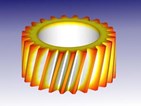
DEFORM-HT predicts heat treating results and can merge them with forging and machining simulations. Heat-treat simulations quantify properties that shop trials cannot - reduce development cost and time for optimum processes and parts.

Columbus, OH New DEFORM-HT heat treating simulation software provides quantitative information on critical process and part-specific variables that has previously been unobtainable before, even with shop trials. The heat treating simulation package can fully integrate its results with related predictions for upstream/downstream operations, such as material production, forming and machining. DEFORM-HT can predict a part's internal microstructure and residual stresses, as well as distortion, quenching stress, and phase transformation.
"DEFORM-HT is unique in its ability to integrate heat treating predictions with other simulations for material production, forging and machining created in the broader DEFORM environment," said John Walters, vice president of the Scientific Forming Technologies. "The standalone module can predict residual stress after heat treatment, along with simulated stress relaxation and aging. More important, it can relate those results to other manufacturing simulations to predict the distortion residual stresses might cause during machining, or show how residual stresses can affect performance during service life. Originally created as a research tool, this software is already being used commercially by industry leaders, such as Bohler, General Electric, Ladish, PCC, Rolls Royce, Timet, Timken and United Technologies."
DEFORM-HT is a standalone finite-element modeling tool that performs "virtual heat treating" on a computer in 2D or 3D, helping achieve an optimum balance of mechanical properties (strength vs. ductility), while avoiding quench cracks and minimizing distortion and residual stresses. It illustrates and quantifies the effects of process variation through sensitivity analyses.
A variety of heat treating processes can be modeled with DEFORM-HT, including normalizing, austenizing, carburizing, solution treating, quenching, tempering, aging and stress relieving. It can predict phase transformation, phase volume fraction, distribution of hardness, case depth after carburizing and grain size. The software can model an extensive variety of metals, including carbon steels, aluminum, titanium and nickel-based alloys. Material models include elasto-plastic, thermal elasto-plastic, and creep.
DEFORM-HT runs under Windows XP/2000 or on popular UNIX workstations. It can be licensed as a 2D or 3D standalone system or as an add-on Microstructure Module for DEFORM-2D or DEFORM-3D. An intuitive graphical user interface makes the software extremely easy to use, and training, support and regular updates are provided by Scientific Forming Technologies Corporation.
SOURCE: DEFORM