
CMS To Present 5-Axis, High-Speed Machining Centre
Dabell Avenue, UK - A new, 5-axis CNC machining centre called ANTARES, intended for machining non-ferrous materials within a 2,600 x 1,500 x 1,200 mm working envelope, will be 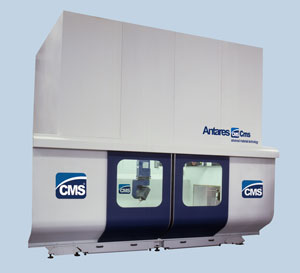 presented by the Italian manufacturer, CMS, at MACH 2008.
According to CMS UK general manager, Toni Nagiel, the concept deliberately tends towards ‘over-engineering' to provide a high degree of robustness, reliability and accuracy. The machines can therefore be used for a wider range of applications than might previously have been envisaged. Confidence in their capabilities is, he says, being borne out by their increasing use in high-technology industries.
Materials regularly machined now extend from wood, aluminium, epoxy paste and polyurethane, commonly found in the mould-, model- and pattern-making sectors, to include light alloys and carbon fibre, as used for the production of structural components in aircraft, for example.
One result of the ANTARES design philosophy is to afford a far higher degree of stiffness to the 5-axis cutting head than is normally associated with machines of this type. The usefulness of this attribute is enhanced by the inclusion of a pneumatic brake that can be programmed to clamp the B and C axes during operations that do not require fully active 5-axis interpolation.
The PX5 universal head, with all five axes acting under simultaneous control from a GE-Fanuc 18i MB5 CNC system, has a fourth, horizontally rotating axis and a fifth that inclines the spindle in the vertical plane, in addition to the three orthogonal linear axes. The highly specified NC control comes complete with PC Office integrated in the electrical cabinet.
High speed
Drawing on the machine tool builder's 35 years of experience, a strong spindle shaft, manufactured in-house, is mounted on two pairs of pre-loaded bearings – ceramic for the front pair and steel for the rear. The high-speed spindle (24,000 rpm max - 12 kW or 27,000 rpm max - 6 kW) is liquid cooled. Fast positioning speeds of 70 - 80 m/min are achieved along with acceleration of up to 3.0 m/s². These are higher if a customer chooses the option of linear motors in X and Y.
Special cycles produced by CMS for surfacing work are linked to the high-speed cutting strategy from Fanuc. It allows the programmer to vary cutting feed rates on the same tool path to optimise both roughing and finishing operations, leading to major productivity gains and high levels of surface quality. Roughing times are typically half those of finishing cycles.
Automatic tool change is from a magazine located on the front face of the traverse. An 8-tool magazine is standard; a 16-tool version is optional.
According to CMS, the combination of a high performance, powerful electro spindle and high machine rigidity assured by the travelling bridge construction offer users high quality machining across a wide range of materials.
SOURCE: CMS