
Metrology Breakthrough Allows 4th Axis Radial Measurement Without a Rotary Table
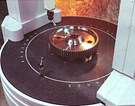
The Radiance Radial Measuring System (RMS) can perform complete full radial scans of non-rotating, unfixtured workpieces such as gears, turbine blades, cones, cylinders, and other shapes within a measuring range of 1 m diameter and 0.6 m vertically without probe changes, reorientation, or a rotary table.
According to TSK America's Advanced Metrology Division (Pine Brook, NJ), gear manufacturers have shown considerable interest in its Radiance 1006 measuring system concept. It is said to be the only measuring system that can automatically measure all features of a gear in a single, unfixtured setup—teeth, shaft diameters, faces and bolt hole circles—replacing the typical combination of coordinate measuring machine and gear checker.
Users can complete a full radial scan of a non-rotating part without probe changes or reorientation, says Jack Epstein, TSK product manager and developer of the Radiance concept. "It permits new levels of freedom for measurement of non-prismatic workpieces that would normally have required multiple probes and a rotary table."
Circling the workpiece for accuracy
The workpiece is stationary and Radiance travels in the surrounding cylindrical coordinates. Eliminated in the process is the need for a rotary table. The infinitely bi-directional rotation of the Radiance bridge provides the 4th axis of measurement while only three axes are in motion. The synchronized motion of two axes provides an interpolated straight line of motion for prismatic work, says Epstein.
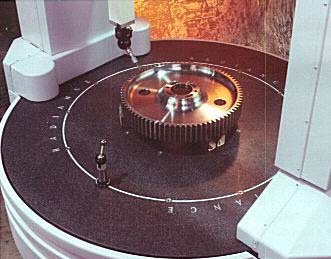
The Radiance Measuring System allows manufacturers to collect information quickly and accurately. Linear accuracy in the X- and Z-axes is 2µm; the U2 (X- and Z-axes) is 2.0 + L/500µm. Angular accuracy is 3 arc-seconds. Acceleration is 1,000mm/s² along the linear axes (X and Z), 250 mm/s² along the Y (rotary) axis with measuring speeds of 250 m/s.
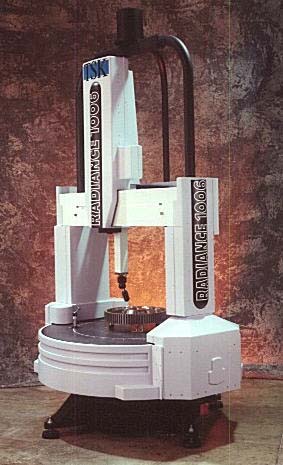
Because the workpiece is stationary, there is no possibility of dynamic error related to varying workpiece loads on a table, such as an off-balance condition. Because there are no accelerating forces on the workpiece, workholding is reduced to a minimum, and, in some cases, is unnecessary. Time saving and measuring reliability for manufacturers of such complex parts as gears represent a quantum leap over that of existing measuring machines, says TSK.
An innovation in mechanical measurement
"This is the first true mechanical innovation in measuring machines since the CMM improved upon the height gage some 50 years ago," says Epstein. Radiance can be used with laser, video, and other types of conventional probes, for contact or noncontact measurement. "Its radial motion interprets the measurement of complex, round parts in a more suitable and reliable way than is possible with a rotary-table system."
The granite surface table is the reference base for the rotational axis of the system. The system's measuring accuracy is substantially supported by this surface plate, which is precisely squared and finished to a Class- 1 flatness. The precision-ground surface plate circumference is designed to provide stability and accuracy over long-term use.
The alloy columns support a ceramic bridge (X-axis) across which travels the ceramic Z-axis ram fitted with the user's choice of probe. The high precision X-guide and Z-axis are designed for high stiffness, high strength, and exceptional resistance to temperature fluctuations and corrosive environments. An additional rotating frame joining the two columns ensures the strength and rigidity of bridge structure.
Smooth, non-contact movement through all axes, including rotational motion, is provided by high rigidity, low-friction flat and radial graphite-composite air bearings with no mechanical backlash. Because of these design features, users can expect high repeatability, accuracy, and performance over the long term.
An electromechanical slip ring at the top of the bridge permits infinitely bi-directional rotation through 360 degrees while maintaining power and control to the system. The use of this component provides a continuous pneumatic and electrical connection between rotating and stationary sections of the machine.
The controller is built-in and includes a high performance single-board computer, motion controller, and the probe system. A dedicated 32-bit controller software module acts as a gateway to the host while controlling motion and data acquisition. The operator interacts with the host application software, which communicates with the controller module. This seamlessly integrated dual computer architecture greatly enhances overall system performance. The host application is a 3D software package for basic geometry. Proprietary airfoil inspection software is also available.
TSK America Advanced Metrology Division, 20 Chapin Road #1003, P.O. Box 838, Pine Brook, NJ 07058; phone: 800-247-9875.